
Introduction
Earthquakes don’t send warnings. There’s no five-day forecast cone, no watch-to-warning progression, no window to run to the store for last-minute supplies. The ground moves, and whatever you have on hand in that moment is what you have to work with which is exactly why an earthquake emergency kit has to be ready long before the shaking starts.
More than 143 million Americans live in areas with some degree of earthquake risk, according to the US Geological Survey, and that risk isn’t limited to California. Alaska, the Pacific Northwest’s Cascadia zone, the New Madrid fault running through the central Mississippi Valley, and parts of the East Coast all carry real seismic exposure. This guide covers exactly what belongs in a functional kit, how to prepare your home structurally, what your family should do in the actual moment of shaking, and how to build a plan that holds up under the kind of stress a sudden disaster creates. No filler, no generic checklists copied from a government PDF just what actually matters when the ground stops cooperating.
Table of Contents
- Why Earthquake Preparedness Is Different From Other Disasters
- Complete Earthquake Emergency Kit Checklist
- Home Earthquake Preparedness Guide
- Emergency Supply Checklist Table
- Family Earthquake Safety Plan
- What to Do Before, During, and After an Earthquake
- Comparison Table: Basic vs. Advanced Earthquake Emergency Kits
- Expert Preparedness Tips
- Common Mistakes to Avoid
- Frequently Asked Questions
- Conclusion & Next Steps
Why Earthquake Preparedness Is Different From Other Disasters
Hurricanes give you a week. Wildfires often give you hours. Earthquakes give you seconds, if that. That single difference reshapes what “preparedness” actually means. You can’t evacuate ahead of an earthquake, and you often can’t reach your car, your basement kit, or even a different room before the shaking is already underway.
That means an earthquake preparedness kit needs to be accessible from wherever you’re likely to be not locked in a garage you can’t safely reach mid-quake. It also means your home itself needs preparation, since falling objects and structural hazards injure far more people during earthquakes than the ground movement itself. This guide treats both halves of that equation as equally important.
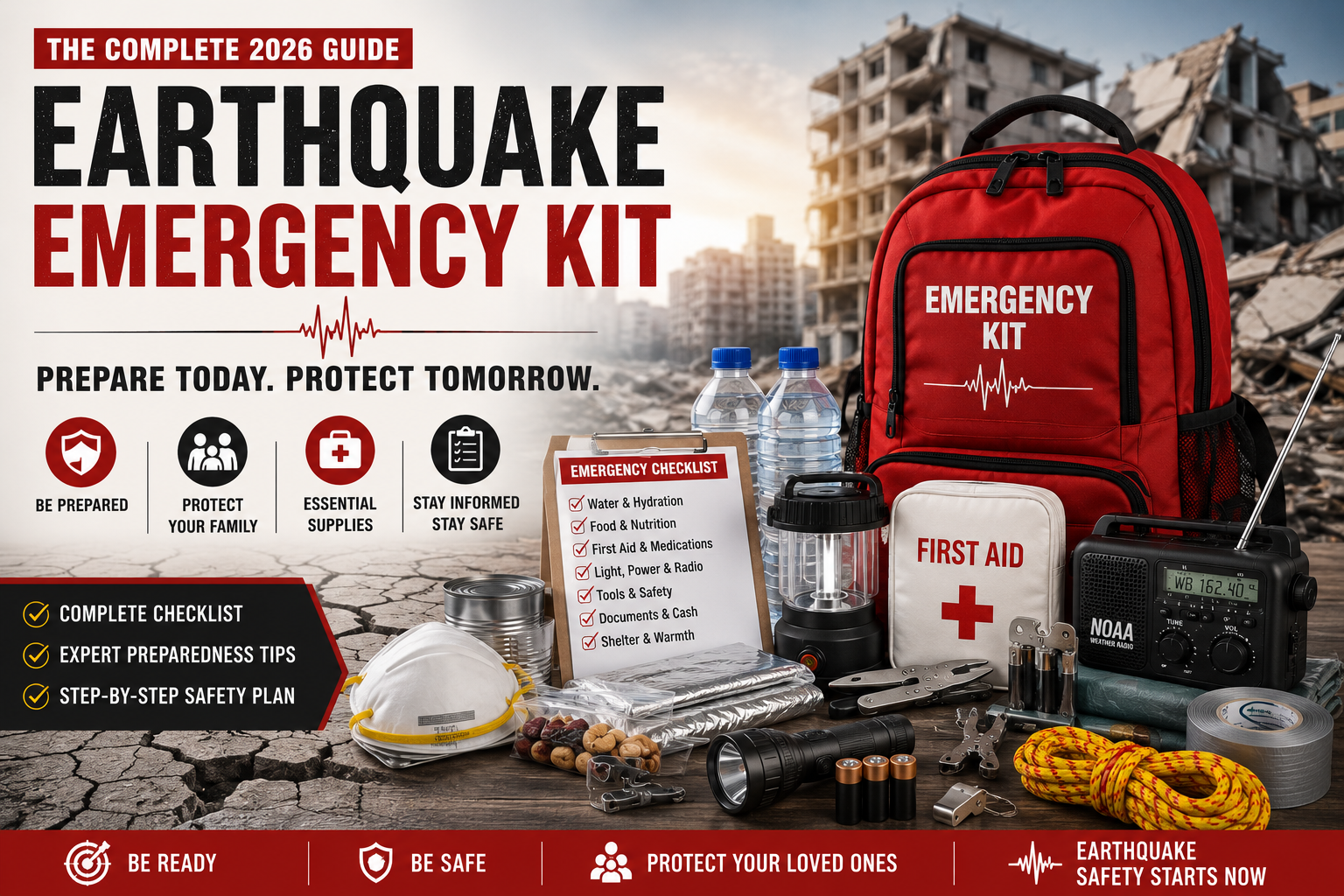
Complete Earthquake Emergency Kit Checklist
Water and Hydration
- 1 gallon of water per person, per day, for at least 7 days
- Water purification tablets or a portable filter as backup
- Collapsible water containers for post-quake water collection if municipal supply is disrupted
Food and Nutrition
- 7-day supply of non-perishable, no-cook food per person
- Manual can opener
- High-calorie, compact options like protein bars and nut butter for the first 24 to 48 hours when cooking may not be possible
Safety and Medical
- A well-stocked trauma kit, since crush injuries, lacerations, and fractures are common in structural collapse scenarios
- 7-day supply of prescription medications
- N95 masks for dust and debris exposure
- Sturdy work gloves and closed-toe shoes kept by the bed, since broken glass on the floor is a common post-quake hazard
Light, Power, and Communication
- Flashlights or headlamps with spare batteries, stored in multiple rooms
- Battery or hand-crank NOAA weather radio
- Portable power bank
- Whistle for signaling if trapped under debris
Tools and Shelter
- Fire extinguisher, since gas line ruptures and electrical fires are a leading secondary hazard after major earthquakes
- Wrench or shutoff tool kept near gas and water valves
- Sturdy tarp and rope for temporary shelter if the home is structurally compromised
- Emergency blanket per household member
Documents and Financial
- Waterproof folder with IDs, insurance policies, and a home inventory
- Cash in small bills, since power outages disable card readers and ATMs
Home Earthquake Preparedness Guide
A kit only solves half the problem. The other half is making sure your home itself doesn’t become the hazard.
- Secure heavy furniture to wall studs, especially bookshelves, dressers, and water heaters, using anti-tip straps or L-brackets
- Anchor top-heavy items and electronics so they can’t topple during shaking
- Move heavy or breakable items off high shelves, particularly above beds and seating areas
- Know your gas, water, and electrical shutoff locations, and keep the correct tool nearby
- Identify safe spots in each room, such as under sturdy furniture or against interior walls away from windows
- Check your foundation and structural bracing if you live in an older home, especially one built before modern seismic codes
- Store breakables and chemicals in latched cabinets rather than open shelving
Emergency Supply Checklist Table
| Category | Item | Recommended Quantity |
|---|---|---|
| Water | Stored water + filter | 1 gal/person/day x 7 days |
| Food | Non-perishable, no-cook meals | 7-day supply per person |
| Medical | Trauma kit, medications | 7-day supply |
| Light | Flashlights, headlamps | 1 per household member |
| Power | Batteries, power bank | 7+ days |
| Communication | NOAA weather radio | 1 per household |
| Tools | Gas/water shutoff wrench | 1 per household |
| Safety | Fire extinguisher, N95 masks, gloves | 1 set per household |
| Documents | IDs, insurance, cash | 1 waterproof folder |
| Shelter | Tarp, rope, emergency blanket | 1 set per household |
Family Earthquake Safety Plan
Supplies matter, but so does knowing what to do in the seconds and hours after shaking starts. Build this plan with the whole household:
- Practice Drop, Cover, and Hold On as a household drill at least twice a year, so it becomes automatic rather than something to think through mid-event
- Identify safe spots in every room you regularly occupy bedrooms, the kitchen, the living room since you won’t have time to move far
- Choose an outdoor meeting point away from buildings, trees, and power lines in case you’re separated
- Pick an out-of-state contact everyone can reach if local phone lines are jammed, which is common immediately after a major quake
- Assign kit locations to specific people, so someone always knows where the nearest supplies are, whether at home, in the car, or at work
- Include children in the plan directly, teaching them the safe spots and meeting point in language appropriate for their age
What to Do Before, During, and After an Earthquake
Before
Secure heavy furniture, identify safe spots in each room, keep your emergency earthquake kit accessible, and practice your family’s response drill regularly enough that it becomes automatic.
During
Drop to the ground, take cover under sturdy furniture or against an interior wall, and hold on until the shaking stops. If you’re in bed, stay there and cover your head with a pillow rather than trying to move. If you’re outdoors, move away from buildings, trees, and power lines and drop in place.
After
Check yourself and others for injuries before moving, expect aftershocks and treat them as seriously as the initial quake, check gas lines for the smell of leaks before using anything with an open flame, and avoid damaged buildings until they’ve been inspected. Use text messages rather than calls when checking in with family, since text often goes through even when voice networks are overloaded.
Comparison Table: Basic vs. Advanced Earthquake Emergency Kits
| Kit Type | Duration | Best For | Key Additions |
|---|---|---|---|
| Basic Kit | 3 days | Apartment dwellers, lower-risk zones | Water, food, flashlight, basic first aid |
| Standard Kit | 7 days | Most households in seismic zones | Full supply list, trauma kit, shutoff tools |
| Advanced Kit | 10–14 days | High-risk zones, older homes, rural areas | Larger water reserve, fire extinguisher, structural shelter supplies |
| Workplace/Car Kit | 1–2 days, portable | Anyone away from home during business hours | Compact, lightweight version for a desk drawer or trunk |
Most households in moderate to high seismic risk areas should build toward the Standard Kit tier, with an Advanced Kit worth considering for older homes or more remote areas where help may take longer to arrive.
Expert Preparedness Tips
- Keep supplies in multiple locations, not just one closet a kit only in the garage doesn’t help if the garage door is jammed by structural shift.
- Store shoes and gloves by every bed. Broken glass on bedroom floors is one of the most common post-quake injuries, and bare feet make it worse.
- Practice the shutoff procedure, not just the checklist item. Knowing where the gas shutoff is and actually being able to turn it off under stress are two different skills.
- Rotate food and water twice a year, tying it to an easy-to-remember date like daylight saving time changes.
- Bolt down water heaters specifically. A toppled water heater is both a fire risk from gas line rupture and a flooding risk from a broken supply line.
- Keep a small kit in your car and at your workplace. Earthquakes don’t wait for you to be home, and commute-hour quakes are a real scenario worth planning for.
Common Mistakes to Avoid
- Storing the entire kit in one place. If that location becomes inaccessible, you’re left with nothing. Spread core supplies across home, car, and workplace.
- Skipping furniture anchoring. Falling furniture and objects cause more earthquake injuries than collapsed structures in most events, and anchoring is inexpensive compared to the risk it addresses.
- Assuming a general emergency kit is enough. Earthquake-specific hazards gas leaks, aftershocks, structural damage require tools and supplies a standard kit often skips.
- Not knowing shutoff locations until after the fact. This is a five-minute task that becomes far harder to figure out during an actual emergency.
- Forgetting to practice the family plan. A plan that’s never been drilled tends to fall apart under real stress, especially with children involved.
- Neglecting workplace or vehicle preparedness. Most people spend a significant portion of their week away from home, and kits built only for the house leave that time uncovered.
Frequently Asked Questions
1. What should be in a basic earthquake emergency kit? At minimum: seven days of water and food per person, a trauma kit, flashlights and batteries, a NOAA weather radio, a gas and water shutoff tool, sturdy shoes and gloves, and copies of important documents in a waterproof folder.
2. How is an earthquake emergency kit different from a general emergency kit? An earthquake kit accounts for specific hazards like gas leaks, aftershocks, and structural debris, and needs to be accessible from multiple locations since there’s no advance warning to reach a single storage spot before shaking starts.
3. How much water should I store for earthquake preparedness? The standard recommendation is one gallon per person, per day, for at least seven days, since municipal water systems can be disrupted for extended periods after a major quake.
4. Where should I store my earthquake emergency kit? Ideally in more than one place a portion at home in an easily reachable spot, a smaller version in your car, and a compact kit at your workplace, since earthquakes can strike at any time regardless of where you are.
5. Do I need a different kit if I live in an apartment versus a house? The core supplies are similar, but apartment dwellers should prioritize a portable, grab-and-go kit since evacuation routes like stairwells may be affected, and homeowners should add furniture anchoring and shutoff tools specific to their structure.
6. What’s the most commonly overlooked item in earthquake preparedness? Shoes and gloves stored by the bed are frequently missed, even though broken glass on bedroom floors is one of the most common sources of post-quake injury during the first few minutes after shaking stops.
7. How often should I update my earthquake preparedness kit? Check it every six months for expired food, water, and medications, and test batteries and radios at the same time. Many households tie this to daylight saving time changes to keep it consistent.
8. What should I do immediately after the shaking stops? Check yourself and others for injuries, expect aftershocks, check for gas odors before using anything with an open flame, avoid entering damaged structures, and use text messages rather than phone calls to check in with family, since text networks often function even when voice lines are overloaded.
Conclusion
An earthquake emergency kit isn’t something you build once and forget in a closet it’s a living part of your household’s safety plan, one that needs to be accessible, current, and practiced. Between securing your home, stocking the right supplies, and making sure everyone in your family knows exactly what to do the moment the ground starts moving, real earthquake preparedness comes down to consistent, practical steps taken well before disaster strikes.
Ready to build a kit that’s actually ready when the ground starts shaking? Explore USADisasterSupply’s full range of earthquake preparedness kits, general emergency supplies, and disaster preparedness kits, including dedicated trauma kits and emergency water storage built to meet the standards in this guide. Don’t wait for the next tremor to start preparing shop USADisasterSupply.com today and get your household ready before disaster strikes.