
Earthquake Preparedness Kit: The Complete 2026 Checklist for Every Home, Office & Business
Introduction
Most earthquake preparedness advice assumes you’re at home when the ground starts shaking. In reality, you spend a large share of your week somewhere else at a desk, in a classroom, running a storefront, sitting in traffic. A seismic event doesn’t check the clock before it hits, which means a preparedness plan that only covers your living room is only covering part of your actual risk.
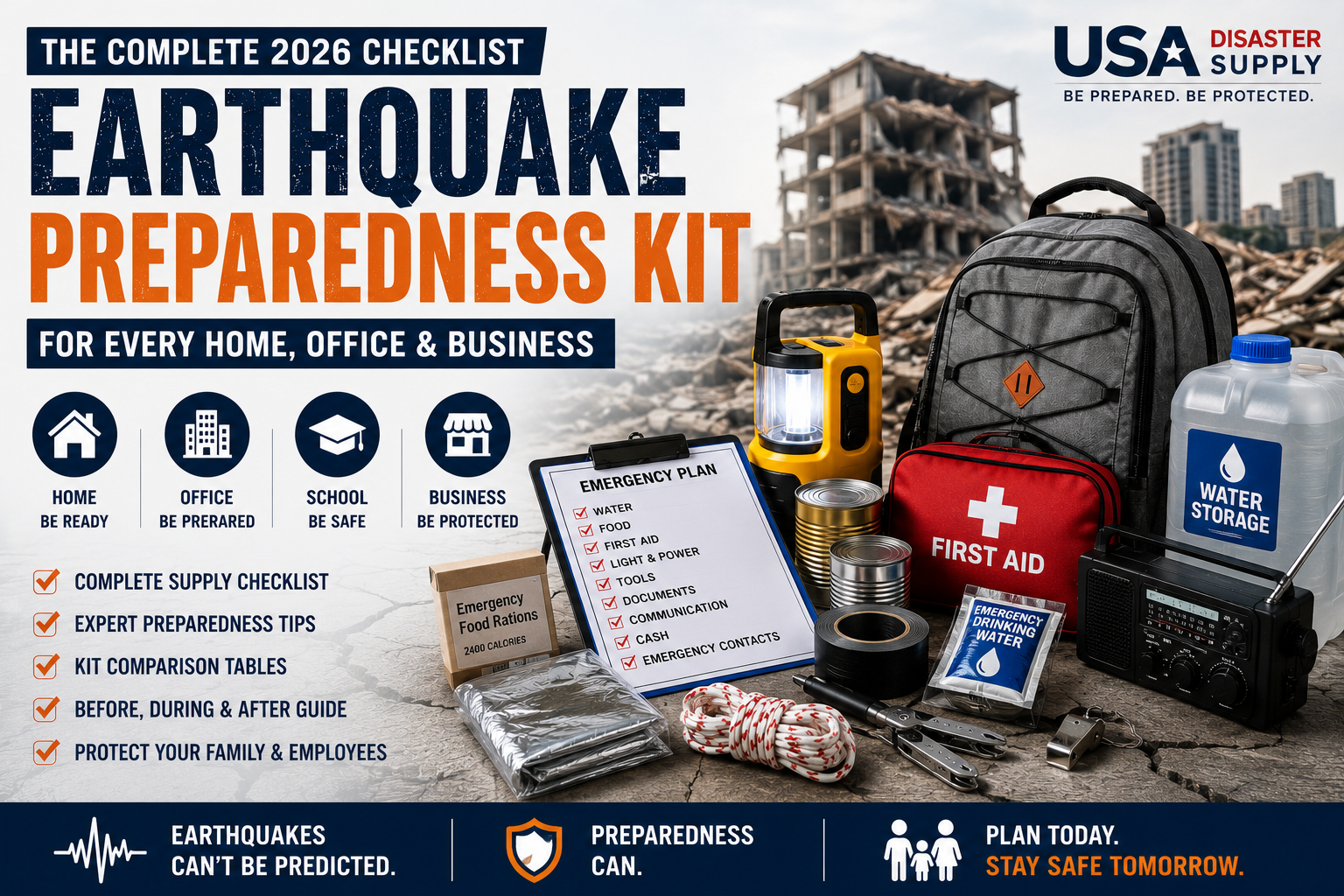
An earthquake preparedness kit needs to work wherever you spend your time, not just at your kitchen table. This guide breaks down exactly what belongs in a kit and how that kit should differ across a home, an office, a school, and a small business along with a full supply checklist, comparison tables, and the kind of practical guidance that comes from looking at what actually helps people during real seismic events, not just what looks complete on a store shelf.
Table of Contents
- What Is an Earthquake Preparedness Kit?
- Complete Earthquake Preparedness Kit Checklist
- Home, Office, School & Business Preparedness Guide
- Essential Emergency Supplies List
- Comparison Table: Basic vs. Advanced Earthquake Preparedness Kits
- Earthquake Preparedness Tips Before, During & After an Earthquake
- Common Mistakes to Avoid
- Expert Recommendations
- Frequently Asked Questions
- Conclusion & Next Steps
What Is an Earthquake Preparedness Kit?
An earthquake preparedness kit is a collection of supplies assembled specifically to help you survive and recover from seismic events not just the shaking itself, but the days that often follow, when water systems, power, and roads may be disrupted. It differs from a general disaster kit in a few key ways: it accounts for structural hazards like gas leaks and debris, it needs to be accessible without warning since earthquakes strike without notice, and it typically includes tools for immediate response, like a shutoff wrench or a trauma kit, rather than just sustaining supplies.
The most important distinction most people miss is that a single kit isn’t enough. Because you can’t predict where you’ll be when an earthquake hits, a complete plan means having appropriately scaled kits in every place you regularly spend time starting with home, but extending to your car, your workplace, and if you have children, their school.
Complete Earthquake Preparedness Kit Checklist
Water and Hydration
- 1 gallon of water per person, per day, for at least 7 days at home
- Water purification tablets or a compact filter for backup
- A smaller sealed water supply for car and desk kits
Food
- 7-day non-perishable food supply per person at home
- Compact, high-calorie options like protein bars for portable kits
- Manual can opener
Medical and Trauma Response
- A comprehensive trauma kit covering lacerations, fractures, and crush injuries earthquake injuries lean heavily toward physical trauma rather than illness, so this is not a place to skimp
- 7-day prescription medication supply
- N95 masks for dust and debris
- Sturdy gloves and closed-toe shoes stored near where you sleep and where you work
Light, Power, and Communication
- Flashlights or headlamps with spare batteries in every kit location
- Hand-crank or battery NOAA weather radio at home
- Portable power bank for phones
- Whistle for signaling if trapped
Tools and Shutoff Equipment
- Gas and water shutoff wrench, kept near the actual valves
- Fire extinguisher, rated for both electrical and gas-related fires
- Pry bar or basic hand tools for clearing minor debris
- Duct tape and heavy plastic sheeting for temporary repairs
Documents and Cash
- Waterproof folder with IDs, insurance policies, and a home or business inventory
- Small bills in cash, since power outages disable card readers
Home, Office, School & Business Preparedness Guide
Home
Anchor heavy furniture, bookshelves, and water heaters to wall studs. Store shoes and gloves by every bed. Keep your main 7-day kit somewhere accessible from multiple rooms, not locked in a single closet or garage that could become blocked.
Office
Keep a compact kit at or near your desk water, a flashlight, a trauma kit, and comfortable shoes for walking if elevators are out of service. Confirm your building’s evacuation routes and designated assembly point, and know whether your office has emergency supplies stocked centrally or whether that responsibility falls to individual employees.
School
Schools should maintain a stocked kit for every classroom, sized for the number of students, along with a larger central supply covering several days in case pickup is delayed by road damage. Drills matter enormously here kids who have practiced Drop, Cover, and Hold On respond far more calmly than kids experiencing it for the first time during a real event.
Business
Retail locations, restaurants, and other public-facing businesses should keep supplies for both employees and potential customers caught on-site, along with a plan for shutting off gas and utilities safely. A business continuity plan how you’ll communicate with staff, secure the location, and resume operations matters as much as the physical kit itself.
Essential Emergency Supplies List
A few categories deserve special attention regardless of setting:
Trauma response supplies. Structural collapse and falling debris cause the majority of earthquake injuries, which makes a real trauma kit not just adhesive bandages one of the highest-value items in any setting.
Footwear and hand protection. Broken glass and debris are near-universal after significant shaking, and having sturdy shoes and gloves within reach can prevent a second injury during the response itself.
Communication tools that don’t rely on cell towers. A hand-crank radio and a family or team communication plan matter more than people expect, since cell networks are frequently overloaded in the hours immediately following a major quake.
Shutoff tools kept exactly where they’re needed. A wrench in a junk drawer three rooms away from the gas valve wastes critical time. Store it at the valve itself.
Comparison Table: Basic vs. Advanced Earthquake Preparedness Kits
| Feature | Basic Kit | Advanced Kit |
|---|---|---|
| Water Supply | 3-day supply | 7 to 14-day supply plus filtration |
| Food | Ready-to-eat bars, canned goods | Full 7+ day non-perishable menu |
| Medical | Basic first aid | Comprehensive trauma kit, prescriptions |
| Tools | Flashlight, batteries | Shutoff wrench, fire extinguisher, pry bar |
| Communication | Charged phone | NOAA radio, power bank, backup plan |
| Best Setting | Car, desk, single-person kits | Home, school, business central supply |
| Ideal For | Portable, grab-and-go coverage | Sustained, multi-day self-sufficiency |
Most households and businesses benefit from layering both: an Advanced Kit as the central supply at home or on-site, paired with Basic Kits distributed in cars, desks, or classrooms for immediate access wherever people actually are when shaking starts.
Earthquake Preparedness Tips Before, During & After an Earthquake
Before
Secure furniture and heavy equipment, know your shutoff locations, distribute kits across every location you spend meaningful time in, and practice Drop, Cover, and Hold On as a household or team at least twice a year.
During
Drop to the ground immediately, take cover under sturdy furniture or against an interior wall, and hold on until shaking fully stops. In an office or school, get under a desk or table rather than attempting to run for an exit during active shaking. Outdoors, move away from buildings and power lines and drop in place.
After
Check for injuries before moving anyone, expect aftershocks and treat them with the same caution as the initial event, check for the smell of gas before using anything with an open flame, and avoid entering damaged structures until they’ve been professionally inspected. Text rather than call when checking in with family or coworkers, since text messages often go through when voice networks are overloaded.
Common Mistakes to Avoid
- Keeping only one kit in one location. If that location is inaccessible when the quake hits, you’re left without supplies at the moment you need them most.
- Underinvesting in trauma supplies. A box of adhesive bandages isn’t equipped to handle the fracture and laceration injuries common in structural events.
- Skipping workplace and school preparedness. Home kits get the attention, but a large share of any given week is spent somewhere else entirely.
- Not practicing shutoff procedures. Knowing where a valve is and being able to shut it off quickly under stress are different skills, and only one of them is built through practice.
- Forgetting to anchor furniture and equipment. Falling objects injure more people during earthquakes than collapsed buildings in most events, and anchoring is a low-cost, high-impact fix.
- Letting kits go stale. Water, food, and medications need to be checked and rotated on a schedule, or the kit becomes unreliable exactly when it matters.
Expert Recommendations
- Layer your kits by location, not just by size. A car kit, a desk kit, and a home kit together cover far more real-world scenarios than one large kit sitting in a single spot.
- Involve your whole team or family in kit maintenance. Assign specific people to check specific supplies twice a year so nothing falls through the cracks.
- Treat trauma kits as a priority purchase, not an afterthought. This is one category worth spending more on rather than assembling from a dollar-store first aid box.
- Run realistic drills, not just verbal walkthroughs. Physically practicing Drop, Cover, and Hold On builds muscle memory that holds up under real stress far better than simply discussing the plan.
- Review your business continuity plan annually. For business owners, the physical kit matters, but so does a written plan for communication, safety checks, and reopening after a significant event.
- Store shutoff tools at the valve, not in a general toolbox. Seconds matter, and searching for a wrench during an active gas leak is a risk worth eliminating in advance.
Frequently Asked Questions
1. What is the difference between an earthquake preparedness kit and a general disaster preparedness kit? An earthquake preparedness kit is built around seismic-specific hazards — structural debris, gas leaks, and sudden onset with no warning while a general disaster preparedness kit covers broader scenarios and may not include shutoff tools or the trauma-focused medical supplies earthquakes tend to require.
2. Do I need separate kits for home, work, and school? Yes. Since earthquakes strike without warning, a kit only at home leaves you unprepared during the hours you spend elsewhere. A layered approach with kits at home, in the car, and at work or school covers far more realistic scenarios.
3. What should a workplace earthquake kit include? At minimum: water, a compact trauma kit, a flashlight, comfortable walking shoes in case elevators are out of service, and a copy of the building’s evacuation plan and assembly point.
4. How much water should a business or school stock for earthquake preparedness? A reasonable baseline is one gallon per person, per day, for at least three days on-site, scaled up for schools or larger businesses where pickup or reopening delays are possible after a significant event.
5. What makes a trauma kit different from a standard first aid kit? A trauma kit includes supplies for more serious injuries common in structural events items like tourniquets, larger gauze rolls, and splinting materials rather than just adhesive bandages and antiseptic wipes meant for minor cuts.
6. How often should schools and businesses run earthquake drills? At least twice a year is a common standard, giving students and employees enough repetition that the Drop, Cover, and Hold On response becomes automatic rather than something to think through during an actual event.
7. What’s the most overlooked item in most earthquake preparedness kits? A gas and water shutoff wrench stored directly at the valve is frequently missing, even though it’s inexpensive and directly addresses one of the most common secondary hazards after a quake gas leaks and resulting fires.
8. How do I maintain an earthquake preparedness kit over time? Check water, food, and medications every six months for expiration, test batteries and radios at the same time, and review your family or team communication plan annually to make sure contact information is still current.
Conclusion
A genuinely complete earthquake preparedness kit isn’t a single bag in a closet it’s a layered system that follows you through your actual week, from home to office to school. Between the right supplies, structural precautions like furniture anchoring, and practiced response plans for every setting you spend time in, real preparedness comes down to consistency across all the places an earthquake might actually find you.
Ready to build a kit that covers your whole week, not just your living room? Explore USADisasterSupply’s full range of earthquake emergency kits, general emergency supplies, and disaster preparedness kits, including dedicated trauma kits and emergency water storage designed for homes, offices, schools, and businesses alike. Don’t wait for the next tremor to find the gaps in your plan shop USADisasterSupply.com today and get every location you spend time in properly prepared.